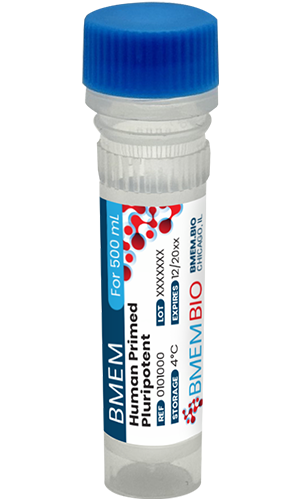
BMEM Pluripotent Kit, comprising of BMEM Basal Medium and Primed Supplement, is a highly optimized, chemically defined, animal origin-free (AOF) kit for the culture of human induced pluripotent stem cells (hiPSCs). BMEM Basal Medium is based on the rigorously optimized published formulation1. Primed Supplement is new supplement specifically optimized for compatibility with adaptation of hiPSCs from legacy media such as mTeSR1. Primed Supplement is optimized for growth factor stability and to allow room temperature shipment.
Increased cell proliferation and upregulation of core primed pluripotency factors1.
Supports longterm maintenance of stable karyotype.
Compatible with weekend-free feeding schedules. Maintains pH throughout weekend.
Compatible with a variety of culture matrices, including Matrigel, Geltrex, Cultrex, Mogengel, laminin 511, vitronectin, and Synthemax.
Compatible with a variety of passaging methods including BMEM Dissociation, TrypLE, ReLeSR, Versene, and EDTA.
Supports tri-lineage differentiation to cardiomyocytes, neural progenitors, and hepatocytes.
Each lot of BMEM Basal Medium and Primed Supplement is performance tested on hiPSC and tested for sterility.
Larger unit sizes are available on request.
View PDF
Instructions for Use
Use sterile technique. Complete BMEM Pluripotent Kit can be used straight from the refrigerator (4 °C) and should not be warmed to RT or 37 °C prior to use.
1. Add 1 mL of BMEM Basal Medium to the vial of Primed Supplement, pipette up and down gently until the powder becomes in solution (~5-10 times). Transfer the solution to the BMEM Basal Medium bottle and wash out the vial with additional BMEM Basal Medium. Gently mix the bottle by inversion.
2. Store complete BMEM at 4 °C for up to 30 days.
ROCK Inhibitor
Addition of a ROCK inhibitor such as 10 µM Y27632 or 20 nM chroman 1 for 24 hours after passage is recommended to provide more reproducible passaging, reduce selective pressure, and allow higher split ratios.
Incubator
hiPSC cultured in BMEM Human Primed Pluripotent should be maintained in a cell culture incubator at 37 °C with a humidified atmosphere of 5% CO2. Hypoxia (5% O2) can be used but is not essential.
Daily media change
For this schedule, media should be changed daily and cells passaged every 4 days when they reach 70-80% confluence. When cells are adapted to BMEM, some lines will be able to be passaged at 1:20 or higher split ratios every four days.
NOTE: If cells do not reach 70-80% confluence in five days then they should be passaged anyway with a variety of lower split ratios (i.e. 1:6, 1:12, 1:15). Do not allow cells to become >90% confluent as this can result in slow growth and unreliable passaging.
Weekend-Free media change
BMEM Pluripotent Kit is compatible with 3.5 days weekend-free protocol.
For this schedule cells should be passaged on Monday morning (with ROCK inhibitor), then media should be changed on Tuesday morning with 3x the volume of media. Cells should be passaged on Thursday afternoon/evening (with ROCK inhibitor), then media should be changed on Friday afternoon/evening with 3x the volume of media. Adjust the split ratio to achieve 70-80% confluence at the time of passage.
Adaptation from legacy media
For the complete protocol on how to adapt cells cultured in legacy media to BMEM or BMEM Max, visit this page.
Product Use
For Research Use Only.
Not for diagnostic procedures.
Reference
- Lyra-Leite, D.M., Copley, R.R., Freeman, P.P., Pongpamorn, P., Shah, D., McKenna, D.E., Lenny, B., Pinheiro, E.A., Weddle, C.J., Gharib, M., et al. (2023). Nutritional requirements of human induced pluripotent stem cells. Stem Cell Reports 18, 1371-1387. https://doi.org/10.1016/j.stemcr.2023.05.004.
1. Slow growth and low confluency at day 4.
- Cause: Split ratio was too high.
Solution: Split more gently at a variety of ratios.
- Cause: Media is too old.
Solution: Complete media should be used within 30 days.
- Cause: Cells were either overconfluent (>90%) or underconfluent (<60%).
Solution: Adjust split ratio of hiPSCs to achieve 70-80% confluency after 4 days of growth.
2. hiPSCs did not attach.
- Cause: No extracellular matrix on the plates or matrix may be too old and have dried out.
Solution: Discard old plates and replace.
- Cause: Cells were overconfluent before passaging and became contact inhibited.
Solution: Adjust split ratio of pluripotent cells to achieve 70-80% confluency after 4 days of growth.
- Cause: Cells were kept in dissociation solution for too long.
Solution: Follow the specific dissociation times for each dissociation reagent.
3. Spontaneous differentiation is observed.
- Cause: Spontaneous differentiation is usually caused by slow growing cells in suboptimal conditions, usually that were grown overly confluent before passaging.
Solution: Obtain new cells and split them at 70-80% confluency.
- Cause: Source of adaptation cells was not pure.
Solution: Obtain a new batch of cells that are guaranteed to be pluripotent before starting the adaptation.
To request the quality certificate use this link.